




 Products
We offer a wide range of products for complete water management solutions.
- Water Softener Plants
- DM Plants
- Ultra Filtration Plants
- Reverse Osmosis Plants(RO)
- Ultra Violet Sterlizers
- STP(Sewage Treatment Plants)
- ETP(Effluent Treatment Plants)
Water Softener Plants
Water softeners are high technology equipments which remove excess amounts of minerals like calcium and magnesium from water, making it soft. It is used to remove ions that cause hardness in water. The process involves using ion exchangers, designed to remove ions, which are positively charged. Water softeners mainly remove calcium and magnesium ions and sometimes may also remove iron ions.
These machines use sodium as the exchange ion and are supplied from dissolved sodium chloride salt. The core of a water softener is a mineral tank, filled with polystyrene beads or resin carrying negative Ions. Since minerals like calcium and magnesium carry positive Ions, they are attracted and absorbed by the negatively charged beads, as the hard water passes through the tank.
Synthetic resin beads or natural zeolites act as the exchange medium. Hardened minerals are collected in a conditioning tank and flushed out from time to time.
Chlorine Dosing System: The chlorinated feed water kills active microbial content of water and ensures that there is no further microbial growth during storage or further treatment of water.
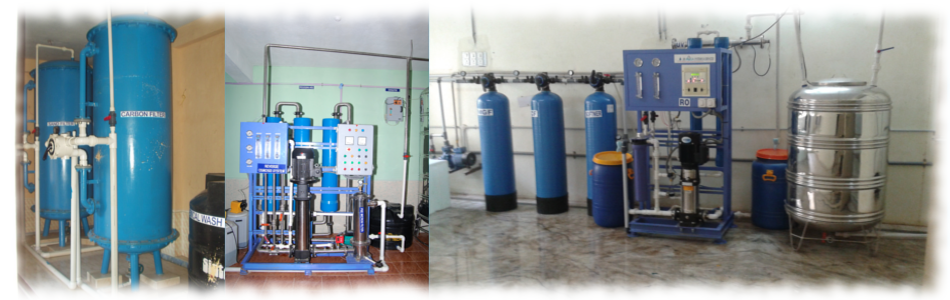
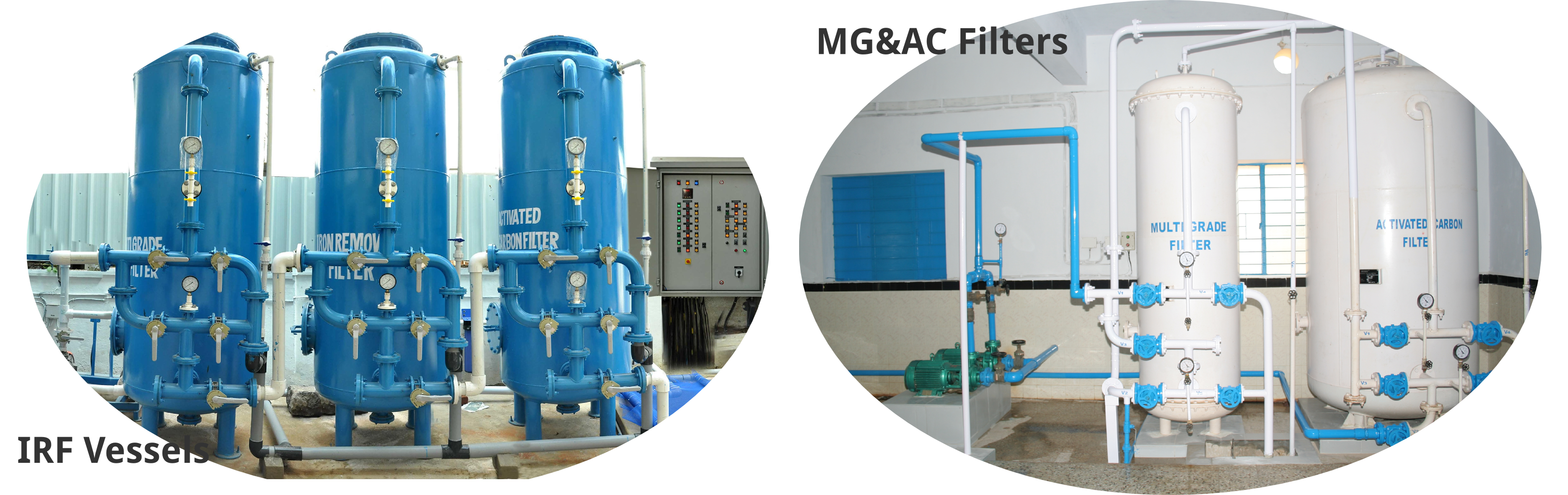
Multi Grade Filter: For removal of suspended particles up to 100 micron. This is a pressurized vessel consisting of sand media for the removal of suspended solids. The unit should be backwashed whenever pressure drop exceeds 0.8 kg/cm2.
Activated Carbon Filter: For the removal of free residual chlorine generated because of hypo dosing. This is a pressurized vessel consisting of activated carbon media for the removal of suspended solids. The unit should be backwashed whenever pressure drop exceeds 0.8 kg/cm2.
Anti scalant Dosing System: Anti scalant are used to control the Scaling tendency of the Membranes. RO Membranes are more susceptible to Scaling and if the same is not controlled properly it may lead to excessive scaling of the membranes which is sometimes irreversible.
Micron Cartridge Filter: A 5 Micron Cartridge Filter is provided to prevent fine particles passage to RO Membranes. This Cartridge Filter has a housing in which cartridges are placed.
Reverse Osmosis Block: Thin Film Composite Semi Permeable Membranes under the influence of external pressure will undergo the process of Reverse Osmosis separating high saline water into Very Low Saline Permeate (more than 99% salinity rejection) and Very Highly saline Reject streams. Feed quality coupled with pre-treatment and membrane selection; determine the recovery that can be obtained through the RO system.
Micron Cartridge Filters 5, 1, & 0.5 µ: A 5, 1, & 0.5 Micron Cartridge Filter is provided to prevent fine particles Present in a RO Permeate Water. This Cartridge Filter has a housing in which cartridges are placed.
UV System: To kill bacteria and viruses carried over through RO permeate.
Ozonator system: To disinfect the treated water and keep it stable for shelf life for certain period for using it for drinking purpose.
DM Plants
Demineralized water also known as Deionized water has had its mineral ions removed. Mineral ions such as cations of sodium, calcium, iron, copper, etc and anions such as chloride, sulphate, nitrate, etc are common ions present in water.
Deionization is a physical process which uses specially-manufactured ion exchange resins which provides ion exchange site for the replacement of the mineral salts in water with water forming H+ and OH- ions. Because the majority of water impurities are dissolved salts, deionization produces a high purity water that is generally similar to distilled water, and this process is quick and without scale buildup.
Ultra Filtration Plants
Ultrafiltration is a type of membrane filtration. Industries such as chemical and pharmaceutical manufacturing, food and beverage processing, and waste water treatment, employ ultrafiltration in order to recycle flow or add value to later products. Ultrafiltration is commonly abbreviated to "UF."
UF's main attraction is its ability to purify, separate, and concentrate targetmacromolecules in continuous systems.
Reverse Osmosis Plants(RO)
Application of an external pressure to the salt solution side equal to the osmotic pressure will also cause equilibrium. Additional pressure will raise the chemical potential of the water in the salt solution and cause a solvent flow to the pure water side, because it now has a lower chemical potential. This phenomenon is called reverse osmosis.
The driving force of the reverse osmosis process is applied pressure. The amount of energy required for osmotic separation is directly related to the salinity of the solution. Thus, more energy is required to produce the same amount of water from solutions with higher concentrations of salt.
Reverse Osmosis is the finest level of filtration available to separate and remove dissolved solids, Organics, Pyrogens, Sub micron Colloidal matter and bacteria from the waste water with the use of Semi Permeable membrane.
Reverse Osmosis is capable of removing 90-95% TDS and 99% of Organics.
Ultra Violet Sterlizers
UV is versatile technology used for disinfecting water, other opaque liquids, hard surfaces and air. Using the same germicidal rays as the sun, but hundreds of times stronger UV offers a reliable, cost effective, environmentally friendly alternative to chemicals and their resulting bi-products. UV Sterilization is a purely physical process not a chemical one so it doesn’t alter water’s chemistry, taste, smell or pH.
STP(Sewage Treatment Plants)
Wastewater (liquid waste) from flushing the toilet, bathing, washing sinks and general cleaning goes down the drain and into a pipe, which joins a larger sewer pipe that leads to the treatment center. Screening is first stage of the wastewater treatment process. Screening removes large objects like, diapers, nappies, sanitary items, cotton buds, face wipes and even broken bottles, bottle tops, plastics and rags that may block or damage equipment.
Special equipment is also used to remove grit that gets washed into the sewer.
PRIMARY TREATMENT:This involve the separation of organic solid matter (or human waste) from the wastewater. This is done by putting the wastewater into large settlement tanks for the solids to sink to the bottom of the tank. The settled solids are called ‘sludge’. At the bottom of these circular tanks, large scrappers continuously scrape the floor of the tank and push the sludge towards the center where it is pumped away for further treatment. The rest of the water is then moved to the Secondary treatment.
SECONDARY TREATMENT:The water, at this stage is put into large rectangular tanks. These are called aeration lanes. Air is pumped into the water to encourage bacteria to breakdown the tiny bits of sludge that escaped the sludge scrapping process.
FINAL TREATMENT:Next the ‘almost’ treated wastewater is passed through a settlement tank. Here, more sludge is formed at the bottom of the tank from the settling of the bacterial action. Again, the sludge is scrapped and collected for treatment. The water at this stage is almost free from harmless substances and chemicals. The water is allowed to flow over a wall where it is filtered through a bed of sand to remove any additional particles.
ETP(Effluent Treatment Plants)
Effluent treatment Plants provide effective solutions to effluent odor control, BOD reduction, aeration, clarification, phosphorous and nitrogen removal and more. Main function of our ETP is to clean industry effluent and recycle it for further use.